ST_ConcaveHull
Signature
GEOMETRY ST_ConvexHull(GEOMETRY geom)
GEOMETRY ST_ConvexHull(GEOMETRY geom, double ratio)
GEOMETRY ST_ConvexHull(GEOMETRY geom, boolean allow_holes)
GEOMETRY ST_ConvexHull(GEOMETRY geom, double ratio, boolean allow_holes)
Description
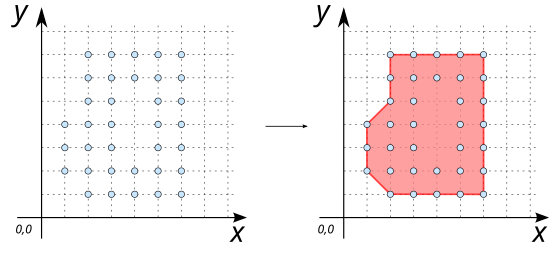
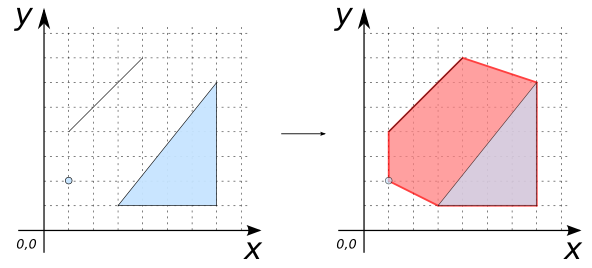
Computes the smallest concave POLYGON that contains all the points of the input geom.
geom can be a set of POINTs, LINESTRINGs, POLYGONs or a GEOMETRYCOLLECTION.
Set allow_holes to TRUE to allow hole in the concave geometry.
Set a ratio value between 0 and 1 to increase the hull concaveness. Values between 0.3 and 0.1 produce reasonable results.
Warning
Whether geom is (MULTI)POINT, (MULTI)LINESTRING or (MULTI)POLYGON, the resulting hull will ONLY enclose the input vertices of geom.
Note
Implements the OpenGIS Simple Features Implementation Specification for SQL version 1.2.1
Examples
With MULTIPOINT’s
SELECT ST_ConcaveHull('MULTIPOINT((1 2), (2 2), (3 2), (4 2), (5 2), (1 3), (3 3),
                                  (5 3), (1 4), (2 4), (3 4), (5 4), (5 5), (5 6))');

-- Answer: POLYGON ((1 3, 1 4, 2 4, 3 4, 5 6, 5 5, 5 4, 5 3, 5 2, 4 2, 3 2, 3 3, 2 2, 1 2, 1 3))
With LINESTRING’s
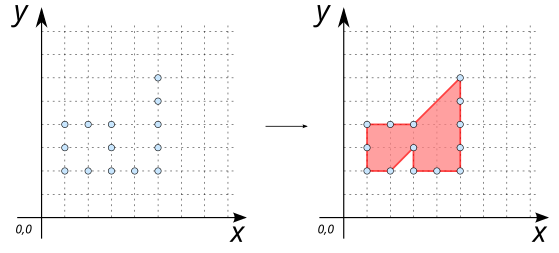
SELECT ST_ConcaveHull('MULTILINESTRING((1 2, 6 1),(1 3, 5 7), (1 4, 4 7),
                                       (5 2, 5 6), (7 1, 6 6))');

-- Answer: POLYGON ((1 3, 1 4, 5 6, 4 7, 5 7, 6 6, 5 2, 7 1, 6 1, 1 2, 1 3))
With POLYGON’s
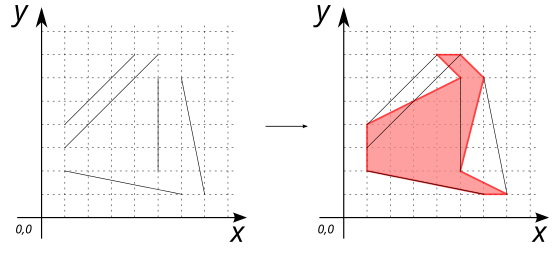
SELECT ST_ConcaveHull('MULTIPOLYGON(((1 3, 5 7, 4 7, 1 4, 1 3)),
                                    ((5 2, 5 6, 6 6, 7 1, 5 2)),
                                    ((1 2, 6 1, 3 2, 1 2)))');

-- Answer: POLYGON ((1 3, 1 4, 5 6, 4 7, 5 7, 6 6, 5 2, 7 1, 6 1, 3 2, 1 2, 1 3))
With GEOMETRYCOLLECTION
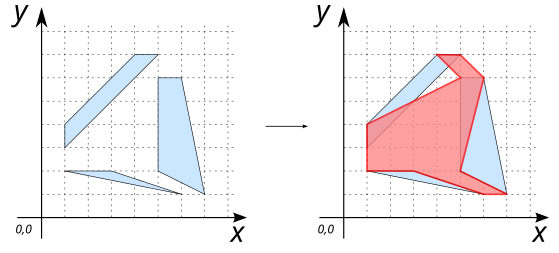
SELECT ST_ConcaveHull('GEOMETRYCOLLECTION(
                        POINT(1 2),
                        LINESTRING(1 4, 4 7),
                        POLYGON((3 1, 7 1, 7 6, 3 1)))');

-- Answer: POLYGON((3 1, 7 1, 7 6, 4 7, 1 4, 1 2, 3 1))
With ratio
SELECT ST_ConcaveHull('MULTIPOINT((1 2), (2 2), (3 2), (4 2), (5 2), (1 3), (3 3),
                                  (5 3), (1 4), (2 4), (3 4), (5 4), (5 5), (5 6))', 0.0);

-- Answer: POLYGON ((1 3, 1 4, 2 4, 3 4, 5 6, 5 5, 5 4, 5 3, 5 2, 4 2, 3 2, 3 3, 2 2, 1 2, 1 3))
SELECT ST_ConcaveHull('MULTIPOINT((1 2), (2 2), (3 2), (4 2), (5 2), (1 3), (3 3),
                                  (5 3), (1 4), (2 4), (3 4), (5 4), (5 5), (5 6))', 0.5);

-- Answer: POLYGON ((1 3, 1 4, 2 4, 3 4, 5 6, 5 5, 5 4, 5 3, 5 2, 4 2, 3 2, 2 2, 1 2, 1 3))
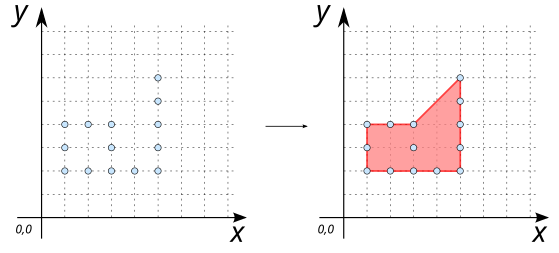
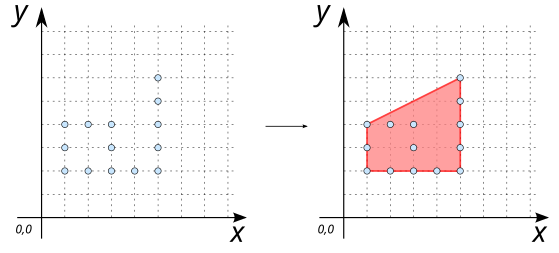
SELECT ST_ConcaveHull('MULTIPOINT((1 2), (2 2), (3 2), (4 2), (5 2), (1 3), (3 3),
                                  (5 3), (1 4), (2 4), (3 4), (5 4), (5 5), (5 6))', 1.0);

-- Answer: POLYGON ((1 3, 1 4, 5 6, 5 5, 5 4, 5 3, 5 2, 4 2, 3 2, 2 2, 1 2, 1 3))
With ratio and allow_holes
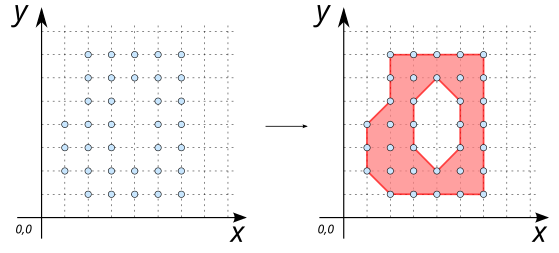
SELECT ST_ConcaveHull('MULTIPOINT ((1 2), (1 3), (1 4), (2 1), (2 2), (2 3), (2 4),
                                   (2 5), (2 6), (2 7), (3 1), (3 2), (3 3), (3 4),
                                   (3 5), (3 6), (3 7), (4 1), (4 2), (4 6), (4 7),
                                   (5 1), (5 2), (5 3), (5 4), (5 5), (5 6), (5 7),
                                   (6 1), (6 2), (6 3), (6 4), (6 5), (6 6), (6 7))',
                                   0.2, TRUE);

-- Answer: POLYGON ((2 7, 3 7, 4 7, 5 7, 6 7, 6 6, 6 5, 6 4, 6 3, 6 2, 6 1, 5 1,
--                   4 1, 3 1, 2 1, 1 2, 1 3, 1 4, 2 5, 2 6, 2 7),
--                  (3 5, 3 4, 3 3, 4 2, 5 3, 5 4, 5 5, 4 6, 3 5))
SELECT ST_ConcaveHull('MULTIPOINT ((1 2), (1 3), (1 4), (2 1), (2 2), (2 3), (2 4),
                                   (2 5), (2 6), (2 7), (3 1), (3 2), (3 3), (3 4),
                                   (3 5), (3 6), (3 7), (4 1), (4 2), (4 6), (4 7),
                                   (5 1), (5 2), (5 3), (5 4), (5 5), (5 6), (5 7),
                                   (6 1), (6 2), (6 3), (6 4), (6 5), (6 6), (6 7))',
                                   0.2, FALSE);

-- Answer: POLYGON ((2 6, 2 7, 3 7, 4 7, 5 7, 6 7, 6 6, 6 5, 6 4, 6 3, 6 2, 6 1,
--                   5 1, 4 1, 3 1, 2 1, 1 2, 1 3, 1 4, 2 5, 2 6))