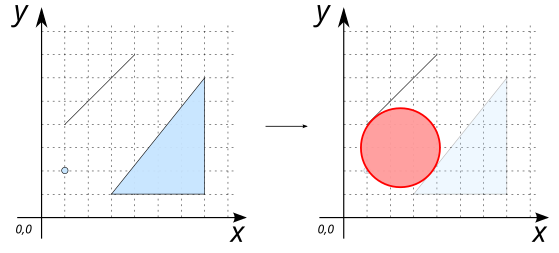
ST_MaximumInscribedCircle
Signature
POLYGON ST_MaximumInscribedCircle(Geometry geom);
Description
Compute the largest empty circle that is contained within a (MULTI)POLYGON geom or the largest empty circle for a set of obstacle geometries (that may be any combination of point, linear and polygonal geometries).
Examples
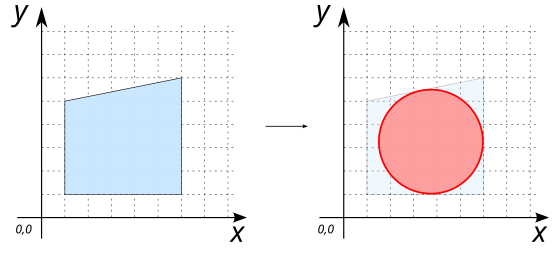
With POLYGON
SELECT ST_MaximumInscribedCircle('POLYGON((1 1, 6 1, 6 6, 1 5, 1 1))');

-- Answer: POLYGON ((5.997895672411477 3.25341796875, 5.954637312072178 2.814208465536505, 5.8265246255825485 2.391877537219978, 5.618480911637965 2.002655124529709, 5.338501173493059 1.6614988265069415, 4.997344875470292 1.3815190883620345, 4.608122462780022 1.173475374417451, 4.185791534463495 1.0453626879278222, 3.74658203125 1.0021043275885222, 3.307372528036505 1.0453626879278222, 2.885041599719978 1.173475374417451, 2.495819187029709 1.381519088362034, 2.1546628890069415 1.6614988265069413, 1.8746831508620343 2.002655124529709, 1.666639436917451 2.3918775372199774, 1.5385267504278222 2.8142084655365043, 1.4952683900885222 3.2534179687499996, 1.5385267504278222 3.6926274719634953, 1.666639436917451 4.114958400280022, 1.874683150862034 4.504180812970291, 2.154662889006941 4.845337110993059, 2.495819187029709 5.125316849137965, 2.885041599719976 5.3333605630825485, 3.3073725280365043 5.461473249572178, 3.7465820312499996 5.504731609911477, 4.185791534463495 5.461473249572178, 4.608122462780023 5.3333605630825485, 4.99734487547029 5.125316849137966, 5.338501173493058 4.845337110993059, 5.618480911637965 4.504180812970291, 5.8265246255825485 4.114958400280024, 5.954637312072178 3.6926274719634957, 5.997895672411477 3.25341796875))
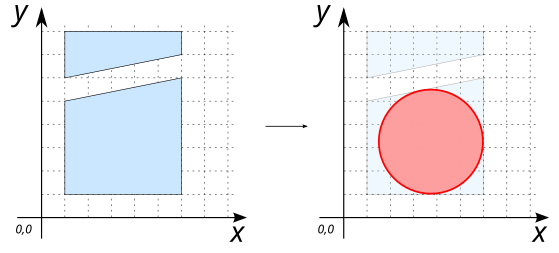
With MULTIPOLYGON
SELECT ST_MaximumInscribedCircle('MULTIPOLYGON(((1 1, 6 1, 6 6, 1 5, 1 1)),
                                                ((1 6, 6 7, 6 8, 1 8, 1 6)))');

-- Answer: POLYGON ((6 3.2509765625, 5.956748116532662 2.8118328200711176, 5.828654611756363 2.389565125389129, 5.620642047223991 2.000400989150212, 5.340704229135735 1.6592957708642657, 4.9995990108497885 1.379357952776009, 4.610434874610871 1.1713453882436369, 4.188167179928882 1.0432518834673377, 3.7490234375 1, 3.3098796950711176 1.0432518834673377, 2.887612000389129 1.1713453882436369, 2.4984478641502124 1.3793579527760085, 2.157342645864266 1.6592957708642655, 1.8774048277760087 2.000400989150212, 1.6693922632436369 2.3895651253891286, 1.5412987584673377 2.8118328200711167, 1.498046875 3.2509765624999996, 1.5412987584673377 3.690120304928883, 1.6693922632436364 4.1123879996108705, 1.8774048277760085 4.501552135849788, 2.157342645864265 4.842657354135734, 2.498447864150212 5.122595172223991, 2.8876120003891277 5.330607736756363, 3.3098796950711167 5.458701241532662, 3.7490234374999996 5.501953125, 4.188167179928882 5.458701241532662, 4.610434874610871 5.330607736756363, 4.999599010849788 5.122595172223992, 5.340704229135734 4.842657354135735, 5.620642047223991 4.5015521358497885, 5.828654611756363 4.112387999610872, 5.956748116532662 3.6901203049288833, 6 3.2509765625))
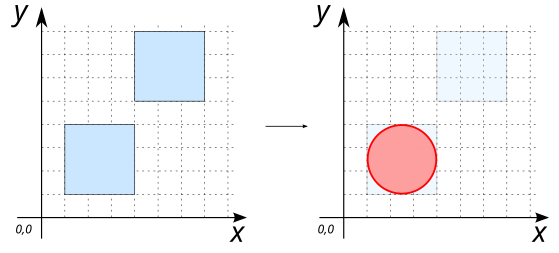
What if input POLYGON’s have the same shape?
In this example, the two input POLYGON’s are the same. In this case, the resulting circle will be place on the first POLYGON.
SELECT ST_MaximumInscribedCircle('MULTIPOLYGON(((1 1, 4 1, 4 4, 1 4, 1 1)),
                                               ((4 5, 7 5, 7 8, 4 8, 4 5)))');
-- Answer: POLYGON ((4 2.5, 3.9711779206048456 2.2073645169758076, 3.88581929876693 1.9259748514523654, 3.747204418453818 1.6666446504705967, 3.5606601717798214 1.4393398282201788, 3.3333553495294037 1.2527955815461822, 3.074025148547635 1.11418070123307, 2.7926354830241924 1.0288220793951544, 2.5 1, 2.2073645169758076 1.0288220793951544, 1.9259748514523654 1.11418070123307, 1.6666446504705972 1.2527955815461818, 1.4393398282201788 1.4393398282201786, 1.252795581546182 1.6666446504705967, 1.11418070123307 1.9259748514523651, 1.0288220793951544 2.207364516975807, 1 2.5, 1.0288220793951544 2.7926354830241924, 1.1141807012330698 3.0740251485476344, 1.2527955815461818 3.333355349529403, 1.4393398282201786 3.560660171779821, 1.6666446504705967 3.747204418453818, 1.9259748514523645 3.88581929876693, 2.207364516975807 3.9711779206048456, 2.4999999999999996 4, 2.7926354830241924 3.9711779206048456, 3.074025148547635 3.88581929876693, 3.333355349529403 3.7472044184538182, 3.560660171779821 3.5606601717798214, 3.747204418453818 3.3333553495294033, 3.88581929876693 3.0740251485476353, 3.9711779206048456 2.792635483024193, 4 2.5))
Big but long POLYGON compared to a more compact one?
In this example we can see that the are of input POLYGON’s is not sufficient. The shape is also important.
SELECT ST_MaximumInscribedCircle('MULTIPOLYGON(((3 1, 6 1, 6 4, 3 4, 3 1)),
                                               ((1 1, 2 1, 2 7, 7 7, 7 1, 8 1, 8 8, 1 8, 1 1)))');

-- Answer: POLYGON ((6 2.50048828125, 5.9712435959159675 2.208519610849886, 5.886079476146042 1.927771132715332, 5.747780450052393 1.669031853415488, 5.561661271648813 1.4422449783511875, 5.334874396584512 1.2561257999476068, 5.076135117284668 1.117826773853958, 4.795386639150114 1.0326626540840327, 4.50341796875 1.00390625, 4.211449298349886 1.0326626540840327, 3.930700820215332 1.117826773853958, 3.6719615409154884 1.2561257999476065, 3.4451746658511873 1.4422449783511873, 3.2590554874476068 1.669031853415488, 3.120756461353958 1.9277711327153317, 3.0355923415840325 2.2085196108498857, 3.0068359375 2.50048828125, 3.0355923415840325 2.792456951650114, 3.120756461353958 3.073205429784668, 3.2590554874476068 3.3319447090845116, 3.4451746658511873 3.5587315841488127, 3.671961540915488 3.7448507625523932, 3.930700820215331 3.8831497886460413, 4.211449298349885 3.9683139084159675, 4.50341796875 3.9970703125, 4.795386639150114 3.9683139084159675, 5.076135117284668 3.8831497886460418, 5.334874396584512 3.7448507625523932, 5.561661271648813 3.5587315841488127, 5.747780450052393 3.331944709084512, 5.886079476146041 3.073205429784669, 5.9712435959159675 2.7924569516501148, 6 2.50048828125))

With GEOMETRYCOLLECTION
SELECT ST_MaximumInscribedCircle('GEOMETRYCOLLECTION(
                        POINT(1 2),
                        LINESTRING(1 4, 4 7),
                        POLYGON((3 1, 7 1, 7 6, 3 1)))');

-- Answer: POLYGON ((4.11910933895815 2.998046875, 4.086309813298998 2.665027702349885, 3.989171703698439 2.3448062697454106, 3.8314279732327416 2.0496885072593183, 3.619140625 1.791015625, 3.360467742740682 1.5787282767672584, 3.0653499802545894 1.4209845463015611, 2.745128547650115 1.3238464367010017, 2.412109375 1.29104691104185, 2.079090202349885 1.3238464367010017, 1.7588687697454106 1.4209845463015611, 1.4637510072593185 1.5787282767672581, 1.205078125 1.791015625, 0.9927907767672581 2.0496885072593183, 0.8350470463015611 2.3448062697454106, 0.7379089367010017 2.6650277023498847, 0.7051094110418501 2.998046875, 0.7379089367010017 3.331066047650115, 0.8350470463015609 3.651287480254589, 0.9927907767672581 3.9464052427406813, 1.2050781249999998 4.205078125, 1.4637510072593183 4.417365473232742, 1.7588687697454097 4.575109203698439, 2.0790902023498843 4.672247313298998, 2.4121093749999996 4.70504683895815, 2.745128547650115 4.672247313298998, 3.06534998025459 4.575109203698439, 3.3604677427406813 4.417365473232742, 3.619140625 4.205078125, 3.8314279732327416 3.9464052427406817, 3.9891717036984384 3.6512874802545903, 4.086309813298998 3.3310660476501157, 4.11910933895815 2.998046875))