ST_Envelope
Signatures
GEOMETRY ST_Envelope(GEOMETRY geom);
GEOMETRY ST_Envelope(GEOMETRY geom, INT srid);
GEOMETRY ST_Envelope(GEOMETRYCOLLECTION geom);
GEOMETRY ST_Envelope(GEOMETRYCOLLECTION geom, INT srid);
Description
Returns the envelope of geom as a Geometry, optionally setting its SRID to
srid. The default SRID is the same as that of geom.
Input type |
Return type |
|---|---|
A |
|
A line parallel to an axis |
A two-vertex |
Otherwise |
A |
Note
Implements the OpenGIS Simple Features Implementation Specification for SQL version 1.2.1
Examples
The envelope of a point is a point
SELECT ST_Envelope('POINT(1 2)', 2154);
-- Answer: POINT(1 2)
This is a line parallel to the x-axis, so only the endpoints are conserved
SELECT ST_Envelope('LINESTRING(1 1, 5 1, 9 1)');
-- Answer: LINESTRING(1 1, 9 1)
(minx miny, maxx miny, maxx maxy, minx maxy, minx miny)
SELECT ST_Envelope('MULTIPOINT(1 2, 3 1, 2 2, 5 1, 1 -1)');
-- Answer: POLYGON((1 -1, 1 2, 5 2, 5 -1, 1 -1))
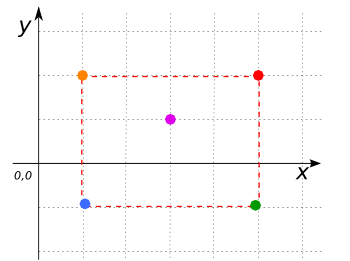
(minx miny, maxx miny, maxx maxy, minx maxy, minx miny)
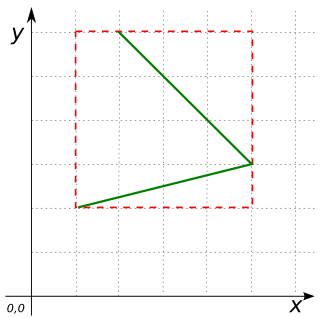
SELECT ST_Envelope('LINESTRING(1 2, 5 3, 2 6)');
-- Answer: POLYGON((1 2, 1 6, 5 6, 5 2, 1 2))
Setting or preserving the SRID
This shows that ST_Envelope preserves the SRID of the input geometry
SELECT ST_SRID(ST_Envelope(
    ST_GeomFromText('LINESTRING(1 1, 5 5)', 27572)))
-- Answer: 27572
This shows that ST_Envelope can set the SRID of Envelope
SELECT ST_SRID(ST_Envelope(
    ST_GeomFromText('LINESTRING(1 1, 5 5)', 27572), 2154))
-- Answer: 2154
Comparison with ST_Extent
CREATE TABLE input_table(geom GEOMETRY);
INSERT INTO input_table VALUES
     ('POLYGON((0 0, 3 -1, 1.5 2, 0 0))'),
     ('POLYGON((2 0, 3 3, 4 2, 2 0))'),
     ('POINT(5 6)'),
     ('LINESTRING(1 1, 1 6)');
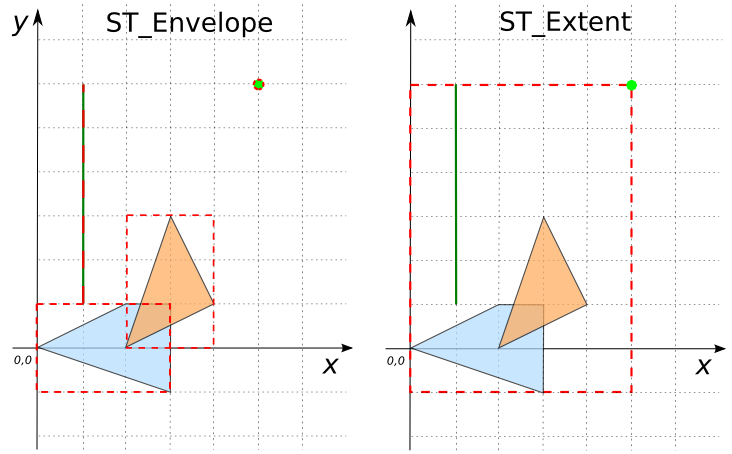
ST_Envelope is a scalar function.
SELECT ST_Envelope(geom) ENV FROM input_table;
Answer:
ENV |
|---|
POLYGON((0 -1, 0 6, 5 6, 5 -1, 0 -1)) |
POLYGON((2 0, 2 3, 4 3, 4 0, 2 0)) |
POINT(5 6) |
LINESTRING(1 1, 1 6) |
ST_Extent is an aggregate function.
SELECT ST_Extent(geom) EXT FROM input_table;
Answer: POLYGON((0 -1, 0 2, 3 2, 3 -1, 0 -1))
However, we can make ST_Envelope behave like ST_Extent as follows:
SELECT ST_Equals(ST_Envelope(ST_Accum(geom)),
                 ST_Extent(geom)) FROM input_table;
Answer: TRUE
Comparison with ST_MinimumRectangle
CREATE TABLE input_table(geom GEOMETRY);
INSERT INTO input_table VALUES
     ('POLYGON((0 0, 3 -1, 3 1, 2 1, 0 0))'),
     ('POLYGON((2 0, 3 3, 4 2, 2 0))'),
     ('POINT(5 6)'),
     ('LINESTRING(1 1, 1 6)');

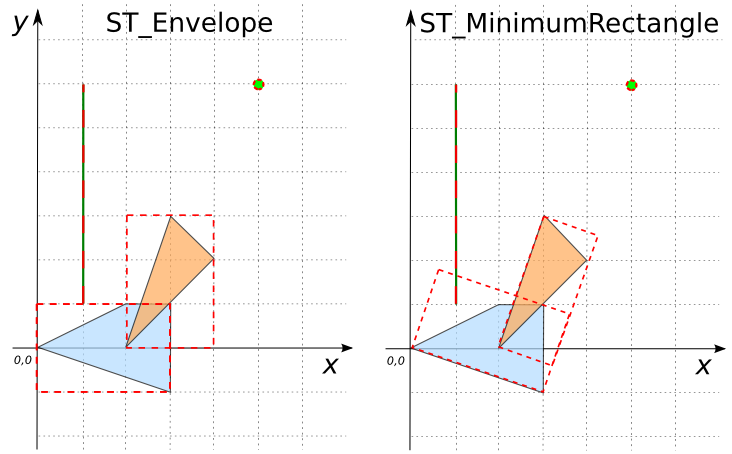
SELECT ST_Envelope(geom) ENV, ST_MinimumRectangle(geom) MinRect
      FROM input_table;
Answer:
ENV |
MinRect |
|---|---|
POLYGON((0 -1, 0 1, 3 1, 3 -1, 0 -1)) |
POLYGON((3 -1, 3.59 0.80, 0.6 1.79, 0 -0, 3 -1)) |
POLYGON((2 0, 2 3, 4 3, 4 0, 2 0)) |
POLYGON((2 -0, 3.2 -0.40, 4.20 2.59, 3 2.99, 2 0)) |
POINT(5 6) |
POINT(5 6) |
LINESTRING(1 1, 1 6) |
LINESTRING(1 1, 1 6) |