ST_Accessibility
Signatures
Return type:
    TABLE[SOURCE, CLOSEST_DEST, DISTANCE]
ST_Accessibility('INPUT_EDGES', 'o[ - eo]'[, 'w'], 'ds');
ST_Accessibility('INPUT_EDGES', 'o[ - eo]'[, 'w'], 'dt');
Description
Calculates, for each vertex in a graph, the closest destination among several possible destinations as well as the distance to this destination.
Tip
Using this function will be faster than doing an equivalent calculation using ST_ShortestPathLength
ST_Accessibility is implemented as follows: The graph is reversed, and Dijkstra’s algorithm is run from each destination vertex. This is much more efficient than running Dijkstra’s algorithm from each vertex to each destination and taking the minimum distance.
Input parameters
Variable |
Meaning |
|---|---|
|
Table containing integer columns |
|
Global orientation string: |
|
Edge orientation column name indicating individual edge orientations: |
|
Edge weights column name |
|
Comma-separated destination string: |
|
Destination table name; must contain column |
Examples
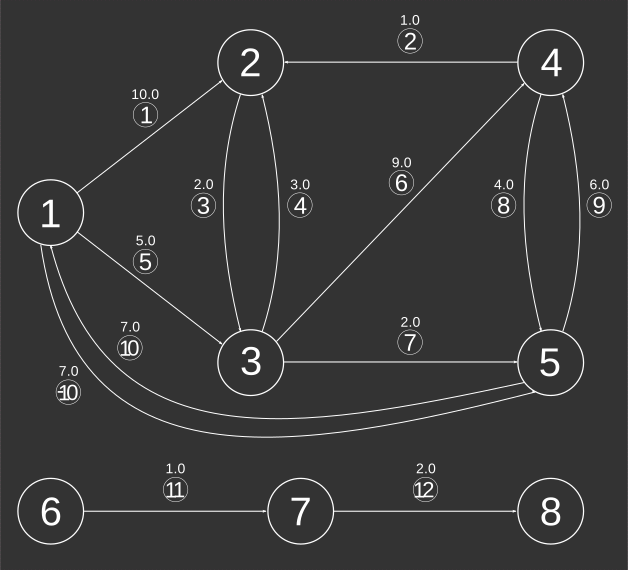
We will do graph analysis on the directed weighted graph examined in the ST_ShortestPath examples, illustrated below
SELECT * FROM EDGES_EO_W;
EDGE_ID |
START_NODE |
END_NODE |
WEIGHT |
EDGE_ORIENTATION |
|---|---|---|---|---|
1 |
1 |
2 |
10.0 |
1 |
2 |
2 |
4 |
1.0 |
-1 |
3 |
2 |
3 |
2.0 |
1 |
4 |
3 |
2 |
3.0 |
1 |
5 |
1 |
3 |
5.0 |
1 |
6 |
3 |
4 |
9.0 |
1 |
7 |
3 |
5 |
2.0 |
1 |
8 |
4 |
5 |
4.0 |
1 |
9 |
5 |
4 |
6.0 |
1 |
10 |
5 |
1 |
7.0 |
0 |
11 |
6 |
7 |
1.0 |
1 |
12 |
7 |
8 |
2.0 |
1 |
Destination string
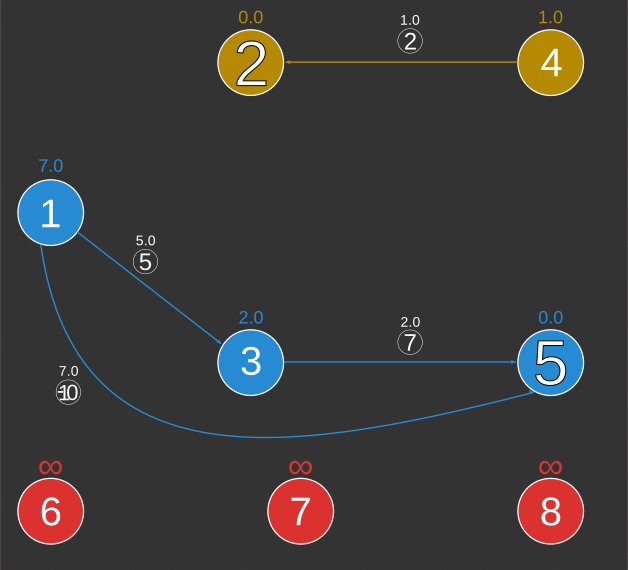
SELECT * FROM ST_Accessibility('EDGES_EO_W',
    'directed - EDGE_ORIENTATION', 'WEIGHT', '2, 5');
SOURCE |
CLOSEST_DEST |
DISTANCE |
|---|---|---|
1 |
5 |
7.0 |
2 |
2 |
0.0 |
4 |
2 |
1.0 |
3 |
5 |
2.0 |
5 |
5 |
0.0 |
6 |
-1 |
Infinity |
7 |
-1 |
Infinity |
8 |
-1 |
Infinity |
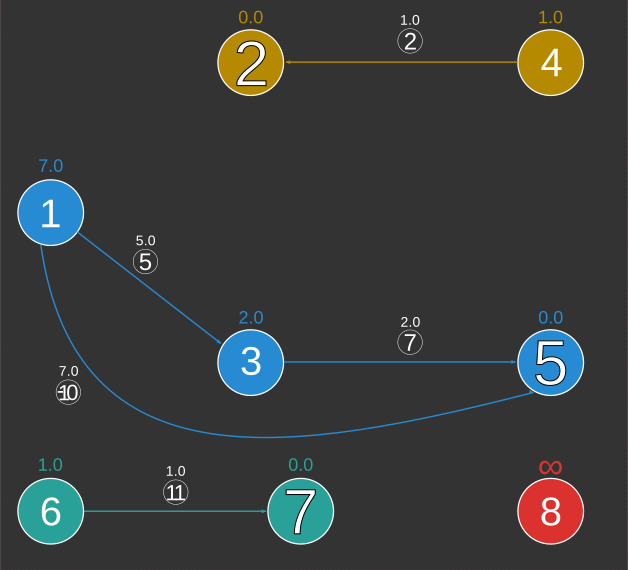
SELECT * FROM ST_Accessibility('EDGES_EO_W',
    'directed - EDGE_ORIENTATION', 'WEIGHT', '2, 5, 7');
SOURCE |
CLOSEST_DEST |
DISTANCE |
|---|---|---|
1 |
5 |
7.0 |
2 |
2 |
0.0 |
4 |
2 |
1.0 |
3 |
5 |
2.0 |
5 |
5 |
0.0 |
6 |
7 |
1.0 |
7 |
7 |
0.0 |
8 |
-1 |
Infinity |
Destination table
Here we get the same results as before, but we do it using a destination table
CREATE TABLE DESTS(DESTINATION INT);
INSERT INTO DESTS VALUES (2), (5), (7);
SELECT * FROM ST_ACCESSIBILITY('EDGES_EO_W',
    'directed - EDGE_ORIENTATION', 'WEIGHT', 'DESTS');
SOURCE |
CLOSEST_DEST |
DISTANCE |
|---|---|---|
1 |
5 |
7.0 |
2 |
2 |
0.0 |
4 |
2 |
1.0 |
3 |
5 |
2.0 |
5 |
5 |
0.0 |
6 |
7 |
1.0 |
7 |
7 |
0.0 |
8 |
-1 |
Infinity |
Exercises
Use
ST_ShortestPathLengthto verify the results ofST_Accessibility.Find an equivalence between
ST_ShortestPathLengthcalled on one source andST_Accessibilitycalled on one destination. Hint: Think about reversing the graph.