ST_ShortestPathLength
Signatures
Input type:
    TABLE[EDGE_ID, START_NODE, END_NODE[, w][, eo]]
Return type:
    TABLE[SOURCE, DESTINATION, DISTANCE]
ST_ShortestPathLength('INPUT_EDGES', 'o[ - eo]'[, 'w'],
                      s, d);    -- One-to-One
ST_ShortestPathLength('INPUT_EDGES', 'o[ - eo]'[, 'w'],
                      s, 'ds'); -- One-to-Several
ST_ShortestPathLength('INPUT_EDGES', 'o[ - eo]'[, 'w'],
                      s);       -- One-to-All
ST_ShortestPathLength('INPUT_EDGES', 'o[ - eo]'[, 'w'],
                      'SDT');   -- Many-to-Many
Description
Calculates the length(s) of shortest path(s) among vertices in a graph. Can be used to calculate distance matrices.
Input parameters
Variable |
Meaning |
|---|---|
|
Table containing integer columns |
|
Global orientation string: |
|
Edge orientation column name indicating individual edge orientations: |
|
Edge weights column name |
|
Source vertex id |
|
Destination vertex id |
|
Comma-separated destination string: |
|
Source-Destination table name; must contain columns |
Examples
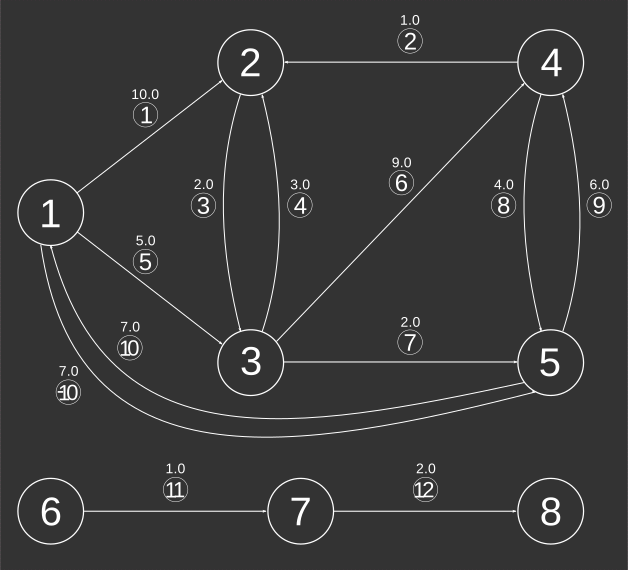
Prepare example data. We give an illustration of the graph this represents below. In order to visualize how these distances are calculated, please see the documentation of ST_ShortestPath and ST_ShortestPathTree.
CREATE TABLE EDGES(EDGE_ID INT AUTO_INCREMENT PRIMARY KEY,
                   START_NODE INT,
                   END_NODE INT,
                   WEIGHT DOUBLE,
                   EDGE_ORIENTATION INT);
INSERT INTO EDGES VALUES
    (DEFAULT, 1, 2, 10.0,  1),
    (DEFAULT, 2, 4,  1.0, -1),
    (DEFAULT, 2, 3,  2.0,  1),
    (DEFAULT, 3, 2,  3.0,  1),
    (DEFAULT, 1, 3,  5.0,  1),
    (DEFAULT, 3, 4,  9.0,  1),
    (DEFAULT, 3, 5,  2.0,  1),
    (DEFAULT, 4, 5,  4.0,  1),
    (DEFAULT, 5, 4,  6.0,  1),
    (DEFAULT, 5, 1,  7.0,  0),
    (DEFAULT, 6, 7,  1.0,  1),
    (DEFAULT, 7, 8,  2.0,  1);
One-to-One
SELECT * FROM
    ST_ShortestPathLength('EDGES',
        'directed - EDGE_ORIENTATION',
        'WEIGHT', 1, 5);
SOURCE |
DESTINATION |
DISTANCE |
|---|---|---|
1 |
5 |
7.0 |
We can obtain just the distance if we want:
SELECT DISTANCE FROM
    ST_ShortestPathLength('EDGES',
        'directed - EDGE_ORIENTATION',
        'WEIGHT', 1, 5);
DISTANCE |
|---|
7.0 |
In an unweighted graph, d(1, 5) is just the number of steps from vertex 1 to vertex 5. They are connected by edge -10.
SELECT * FROM
    ST_ShortestPathLength('EDGES',
        'directed - EDGE_ORIENTATION',
        1, 5);
SOURCE |
DESTINATION |
DISTANCE |
|---|---|---|
1 |
5 |
1.0 |
The distance function is not necessarily symmetric in directed graphs: d(a, b) != d(b, a)
SELECT (SELECT DISTANCE FROM
            ST_ShortestPathLength('EDGES',
                'directed - EDGE_ORIENTATION',
                'WEIGHT', 1, 3)) DIST_1_3,
       (SELECT DISTANCE FROM
            ST_ShortestPathLength('EDGES',
                'directed - EDGE_ORIENTATION',
                'WEIGHT', 3, 1)) DIST_3_1;
DIST_1_3 |
DIST_3_1 |
|---|---|
5.0 |
9.0 |
However, it is symmetric in undirected graphs:
SELECT (SELECT DISTANCE FROM
            ST_ShortestPathLength('EDGES',
                'undirected',
                'WEIGHT', 1, 3)) DIST_1_3,
       (SELECT DISTANCE FROM
            ST_ShortestPathLength('EDGES',
                'undirected',
                'WEIGHT', 3, 1)) DIST_3_1;
DIST_1_3 |
DIST_3_1 |
|---|---|
5.0 |
5.0 |
Vertex 6 is not reachable from vertex 1.
SELECT * FROM
    ST_ShortestPathLength('EDGES',
        'directed - EDGE_ORIENTATION',
        'WEIGHT', 1, 6);
SOURCE |
DESTINATION |
DISTANCE |
|---|---|---|
1 |
6 |
Infinity |
One-to-Several
Here we calculate d(1, 3), d(1, 5) and d(1, 6) in a single request. Since vertex 6 is not reachable from vertex 1, it is not returned in the list.
SELECT * FROM
    ST_ShortestPathLength('EDGES',
        'directed - EDGE_ORIENTATION',
        'WEIGHT', 1, '3, 5, 6');
SOURCE |
DESTINATION |
DISTANCE |
|---|---|---|
1 |
3 |
5.0 |
1 |
5 |
7.0 |
One-to-All
Here we calculate d(1, *), i.e., the distance from vertex 1 to all reachable vertices. Notice that vertices 6, 7 and 8 are not reachable from vertex 1, so they do not show up in the list.
SELECT * FROM
    ST_ShortestPathLength('EDGES',
        'directed - EDGE_ORIENTATION',
        'WEIGHT', 1);
SOURCE |
DESTINATION |
DISTANCE |
|---|---|---|
1 |
4 |
13.0 |
1 |
3 |
5.0 |
1 |
2 |
8.0 |
1 |
5 |
7.0 |
1 |
1 |
0.0 |
The only vertices reachable from vertex 6 are vertices 6, 7 and 8.
SELECT * FROM
    ST_ShortestPathLength('EDGES',
        'directed - EDGE_ORIENTATION',
        'WEIGHT', 6);
SOURCE |
DESTINATION |
DISTANCE |
|---|---|---|
6 |
7 |
1.0 |
6 |
8 |
3.0 |
6 |
6 |
0.0 |
Many-to-Many (distance matrices)
Create a source-destination table:
CREATE TABLE SDT(SOURCE INT,
                 DESTINATION INT) AS
    SELECT A.X, B.X
    FROM SYSTEM_RANGE(1, 8) A,
         SYSTEM_RANGE(1, 8) B;
Only vertices reachable from each source are returned.
SELECT * FROM
    ST_ShortestPathLength('EDGES',
        'directed - EDGE_ORIENTATION',
        'WEIGHT', 'SDT')
    ORDER BY SOURCE, DESTINATION ASC;
SOURCE |
DESTINATION |
DISTANCE |
|---|---|---|
1 |
1 |
0.0 |
1 |
2 |
8.0 |
1 |
3 |
5.0 |
1 |
4 |
13.0 |
1 |
5 |
7.0 |
2 |
1 |
11.0 |
2 |
2 |
0.0 |
2 |
3 |
2.0 |
2 |
4 |
10.0 |
2 |
5 |
4.0 |
3 |
1 |
9.0 |
3 |
2 |
3.0 |
3 |
3 |
0.0 |
3 |
4 |
8.0 |
3 |
5 |
2.0 |
4 |
1 |
11.0 |
4 |
2 |
1.0 |
4 |
3 |
3.0 |
4 |
4 |
0.0 |
4 |
5 |
4.0 |
5 |
1 |
7.0 |
5 |
2 |
7.0 |
5 |
3 |
9.0 |
5 |
4 |
6.0 |
5 |
5 |
0.0 |
6 |
6 |
0.0 |
6 |
7 |
1.0 |
6 |
8 |
3.0 |
7 |
7 |
0.0 |
7 |
8 |
2.0 |
8 |
8 |
0.0 |
The following example shows that the distance matrix D’ of a graph G’ whose edges are obtained from a graph G by reversing the orientation of every edge is the transpose of the distance matric D of G: D’ = D_transpose.
SELECT * FROM
    ST_ShortestPathLength('EDGES',
        'reversed - EDGE_ORIENTATION',
        'WEIGHT', 'SDT')
    ORDER BY DESTINATION, SOURCE ASC;
SOURCE |
DESTINATION |
DISTANCE |
|---|---|---|
1 |
1 |
0.0 |
2 |
1 |
8.0 |
3 |
1 |
5.0 |
4 |
1 |
13.0 |
5 |
1 |
7.0 |
1 |
2 |
11.0 |
2 |
2 |
0.0 |
3 |
2 |
2.0 |
4 |
2 |
10.0 |
5 |
2 |
4.0 |
1 |
3 |
9.0 |
2 |
3 |
3.0 |
3 |
3 |
0.0 |
4 |
3 |
8.0 |
5 |
3 |
2.0 |
1 |
4 |
11.0 |
2 |
4 |
1.0 |
3 |
4 |
3.0 |
4 |
4 |
0.0 |
5 |
4 |
4.0 |
1 |
5 |
7.0 |
2 |
5 |
7.0 |
3 |
5 |
9.0 |
4 |
5 |
6.0 |
5 |
5 |
0.0 |
6 |
6 |
0.0 |
7 |
6 |
1.0 |
8 |
6 |
3.0 |
7 |
7 |
0.0 |
8 |
7 |
2.0 |
8 |
8 |
0.0 |