ST_ShortestPathTree
Signatures
-- Input type:
--     TABLE[EDGE_ID, START_NODE, END_NODE[, w][, eo][, THE_GEOM]]
-- Return type:
--     TABLE[[THE_GEOM, ]EDGE_ID, SOURCE, DESTINATION, WEIGHT]
ST_ShortestPathTree('INPUT_EDGES', 'o[ - eo]'[, 'w'], s)
ST_ShortestPathTree('INPUT_EDGES', 'o[ - eo]'[, 'w'], s, r)
Description
Calculates the shortest path tree (SPT) from a given vertex of a graph using Dijkstra’s algorithm.
Note
The result may not technically be a tree
If there are multiple shortest paths, they are all returned
Hint
Edges are not returned in any particular order
The SPT is composed of many edges, but their order is not important.
Hint
The SPT is confined to the same (strongly) connected component as the source vertex
That is, it includes only vertices reachable from the source vertex. See ST_ConnectedComponents
Input parameters
Variable |
Meaning |
|---|---|
|
Table containing integer columns |
|
Global orientation string: |
|
Edge orientation column name indicating individual edge orientations: |
|
Edge weights column name |
|
Source vertex id |
|
Radius by which to limit the search (a |
Examples
In the following examples, we will use the geometrical data below as input.
DROP TABLE IF EXISTS INPUT;
CREATE TABLE INPUT(THE_GEOM GEOMETRY(LINESTRING),
                   ID INT AUTO_INCREMENT PRIMARY KEY,
                   WEIGHT DOUBLE,
                   EDGE_ORIENTATION INT);
INSERT INTO INPUT VALUES
    ('LINESTRING (0 1, 1 2)', DEFAULT, 10.0, 1),
    ('LINESTRING (1 2, 2 2)', DEFAULT, 1.0, -1),
    ('LINESTRING (1 2, 0.75 1, 1 0)', DEFAULT, 2.0,  1),
    ('LINESTRING (1 0, 1.25 1, 1 2)', DEFAULT, 3.0,  1),
    ('LINESTRING (0 1, 1 0)', DEFAULT, 5.0,  1),
    ('LINESTRING (1 0, 2 2)', DEFAULT, 9.0,  1),
    ('LINESTRING (1 0, 2 0)', DEFAULT, 2.0,  1),
    ('LINESTRING (2 2, 1.75 1, 2 0)', DEFAULT, 4.0,  1),
    ('LINESTRING (2 0, 2.25 1, 2 2)', DEFAULT, 6.0,  1),
    ('LINESTRING (2 0, 0 1)', DEFAULT, 7.0,  0),
    ('LINESTRING (3 0, 3 1)', DEFAULT, 1.0, 1),
    ('LINESTRING (3 1, 3 2)', DEFAULT, 2.0, 1);
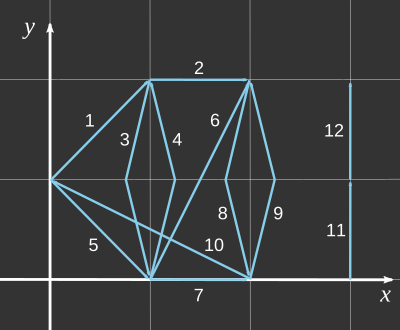
We call ST_Graph on this input table in order to construct the node and edge tables. We give an illustration of the resulting graph. Note that we can call this function on any table containing integer columns EDGE_ID, START_NODE and END_NODE.
DROP TABLE IF EXISTS INPUT_NODES;
DROP TABLE IF EXISTS INPUT_EDGES;
CALL ST_Graph('INPUT');
SELECT * FROM INPUT_EDGES;
EDGE_ID |
START_NODE |
END_NODE |
|---|---|---|
1 |
1 |
2 |
2 |
2 |
4 |
3 |
2 |
3 |
4 |
3 |
2 |
5 |
1 |
3 |
6 |
3 |
4 |
7 |
3 |
5 |
8 |
4 |
5 |
9 |
5 |
4 |
10 |
5 |
1 |
11 |
6 |
7 |
12 |
7 |
8 |
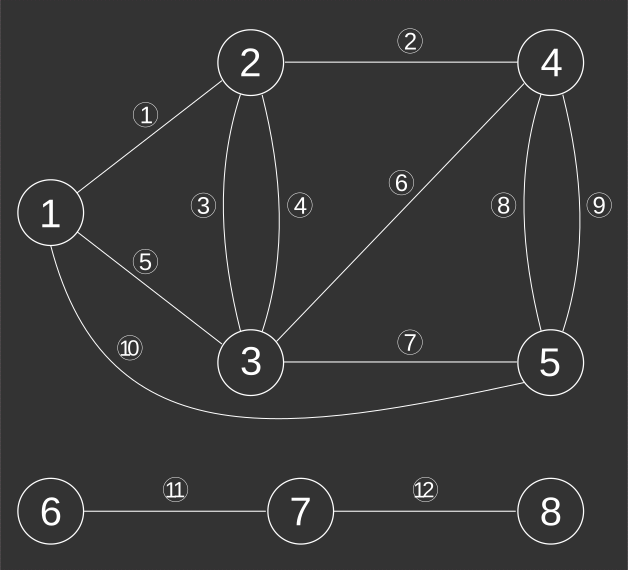
Undirected unweighted
We have just enough information to consider an unweighted undirected graph. Notice this is not really a “tree” in the mathematical sense since there are four shortest paths from vertex 1 to vertex 4.
SELECT * FROM ST_ShortestPathTree('INPUT_EDGES', 'undirected', 1);
EDGE_ID |
SOURCE |
DESTINATION |
WEIGHT |
|---|---|---|---|
1 |
1 |
2 |
1.0 |
9 |
5 |
4 |
1.0 |
6 |
3 |
4 |
1.0 |
2 |
2 |
4 |
1.0 |
8 |
5 |
4 |
1.0 |
5 |
1 |
3 |
1.0 |
10 |
1 |
5 |
1.0 |
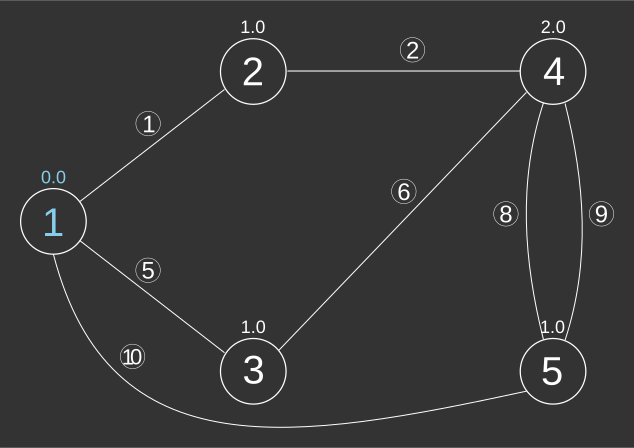
Directed Weighted
If we want to take edge orientations and weights into account, we have to recover that information from the original input table. Notice that edge 2 is reversed and edge 10 is bidirectional (represented by edges 10 and -10 in opposite directions).
DROP TABLE IF EXISTS EDGES_EO_W;
CREATE TABLE EDGES_EO_W(EDGE_ID INT PRIMARY KEY,
                        START_NODE INT,
                        END_NODE INT,
                        WEIGHT DOUBLE,
                        EDGE_ORIENTATION INT) AS
    SELECT B.EDGE_ID,
           B.START_NODE,
           B.END_NODE,
           A.WEIGHT,
           A.EDGE_ORIENTATION
    FROM INPUT A, INPUT_EDGES B
    WHERE A.ID=B.EDGE_ID;
SELECT * FROM EDGES_EO_W;
EDGE_ID |
START_NODE |
END_NODE |
WEIGHT |
EDGE_ORIENTATION |
|---|---|---|---|---|
1 |
1 |
2 |
10.0 |
1 |
2 |
2 |
4 |
1.0 |
-1 |
3 |
2 |
3 |
2.0 |
1 |
4 |
3 |
2 |
3.0 |
1 |
5 |
1 |
3 |
5.0 |
1 |
6 |
3 |
4 |
9.0 |
1 |
7 |
3 |
5 |
2.0 |
1 |
8 |
4 |
5 |
4.0 |
1 |
9 |
5 |
4 |
6.0 |
1 |
10 |
5 |
1 |
7.0 |
0 |
11 |
6 |
7 |
1.0 |
1 |
12 |
7 |
8 |
2.0 |
1 |
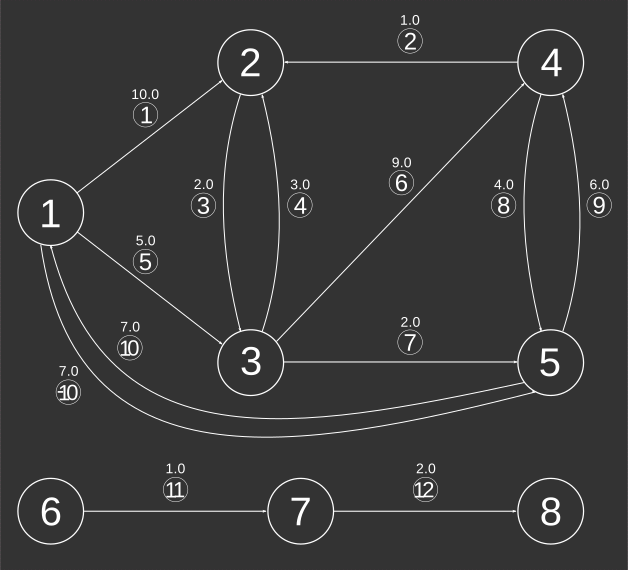
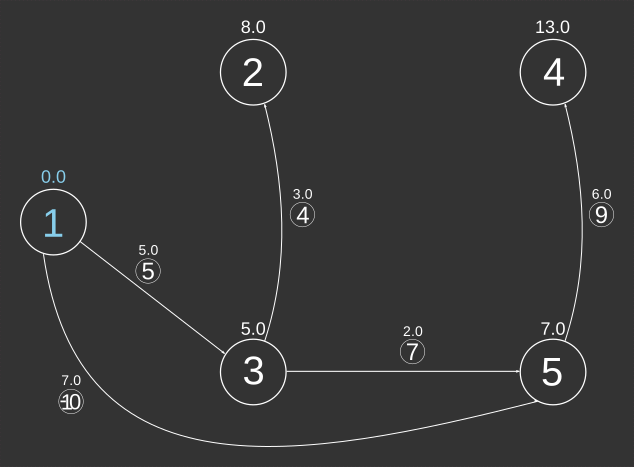
Now we may consider a directed weighted graph. Again, notice this is not really a “tree” in the mathematical sense since there are two shortest paths from vertex 1 to vertex 5.
SELECT * FROM ST_ShortestPathTree('EDGES_EO_W',
        'directed - EDGE_ORIENTATION', 'WEIGHT', 1);
EDGE_ID |
SOURCE |
DESTINATION |
WEIGHT |
|---|---|---|---|
4 |
3 |
2 |
3.0 |
9 |
5 |
4 |
6.0 |
5 |
1 |
3 |
5.0 |
-10 |
1 |
5 |
7.0 |
7 |
3 |
5 |
2.0 |
Including Geometries
To include Geometries in the result, there are two methods.
METHOD 1: Include Geometries in the input table.
DROP TABLE IF EXISTS EDGES_EO_W_GEOM;
CREATE TABLE EDGES_EO_W_GEOM(EDGE_ID INT PRIMARY KEY,
                             START_NODE INT,
                             END_NODE INT,
                             EDGE_ORIENTATION INT,
                             WEIGHT DOUBLE,
                             THE_GEOM GEOMETRY) AS
    SELECT B.EDGE_ID,
           B.START_NODE,
           B.END_NODE,
           A.EDGE_ORIENTATION,
           A.WEIGHT,
           A.THE_GEOM
    FROM INPUT A, INPUT_EDGES B
    WHERE A.ID=B.EDGE_ID;
The input table’s Geometries are automatically returned in the result.
SELECT * FROM ST_ShortestPathTree('EDGES_EO_W_GEOM',
        'directed - EDGE_ORIENTATION', 'weight', 1);
THE_GEOM |
EDGE_ID |
SOURCE |
DESTINATION |
WEIGHT |
|---|---|---|---|---|
LINESTRING (1 0, 1.25 1, 1 2) |
4 |
3 |
2 |
3.0 |
LINESTRING (2 0, 2.25 1, 2 2) |
9 |
5 |
4 |
6.0 |
LINESTRING (0 1, 1 0) |
5 |
1 |
3 |
5.0 |
LINESTRING (2 0, 0 1) |
-10 |
1 |
5 |
7.0 |
LINESTRING (1 0, 2 0) |
7 |
3 |
5 |
2.0 |
METHOD 2: Recover Geometries after calculation.
Notice the call to the ABS function (edge ids could be negative). We get the same result.
SELECT A.THE_GEOM,
       B.EDGE_ID,
       B.SOURCE,
       B.DESTINATION,
       B.WEIGHT
FROM INPUT A,
     (SELECT * FROM ST_ShortestPathTree('EDGES_EO_W',
                 'directed - EDGE_ORIENTATION', 'weight', 1)) B
WHERE A.ID=ABS(B.EDGE_ID);
THE_GEOM |
EDGE_ID |
SOURCE |
DESTINATION |
WEIGHT |
|---|---|---|---|---|
LINESTRING (1 0, 1.25 1, 1 2) |
4 |
3 |
2 |
3.0 |
LINESTRING (2 0, 2.25 1, 2 2) |
9 |
5 |
4 |
6.0 |
LINESTRING (0 1, 1 0) |
5 |
1 |
3 |
5.0 |
LINESTRING (2 0, 0 1) |
-10 |
1 |
5 |
7.0 |
LINESTRING (1 0, 2 0) |
7 |
3 |
5 |
2.0 |
Limiting by search radius
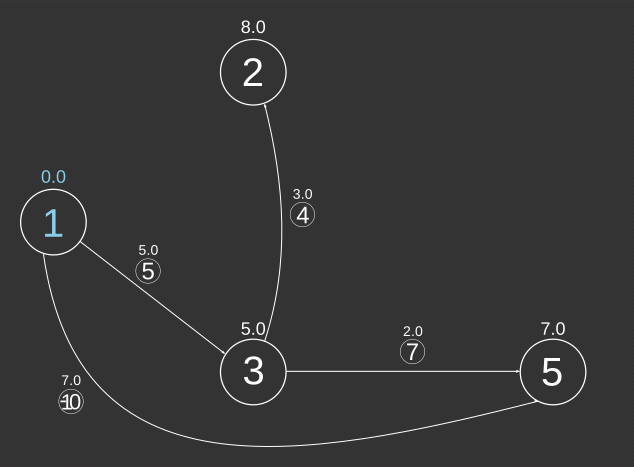
Notice that now edge 9 is no longer a part of the SPT since d(1, 4)=13.0 > 8.5.
SELECT * FROM ST_ShortestPathTree('EDGES_EO_W',
        'directed - EDGE_ORIENTATION', 'WEIGHT', 1, 8.5);
EDGE_ID |
SOURCE |
DESTINATION |
WEIGHT |
|---|---|---|---|
4 |
3 |
2 |
3.0 |
5 |
1 |
3 |
5.0 |
7 |
3 |
5 |
2.0 |
-10 |
1 |
5 |
7.0 |
Exercises
Try doing similar calculations for
an unweighted directed graph
a weighted undirected graph
a weighted reversed graph
Find a source vertex and a graph configuration such that the SPT returned by
ST_ShortestPathTreeis in fact a tree.